
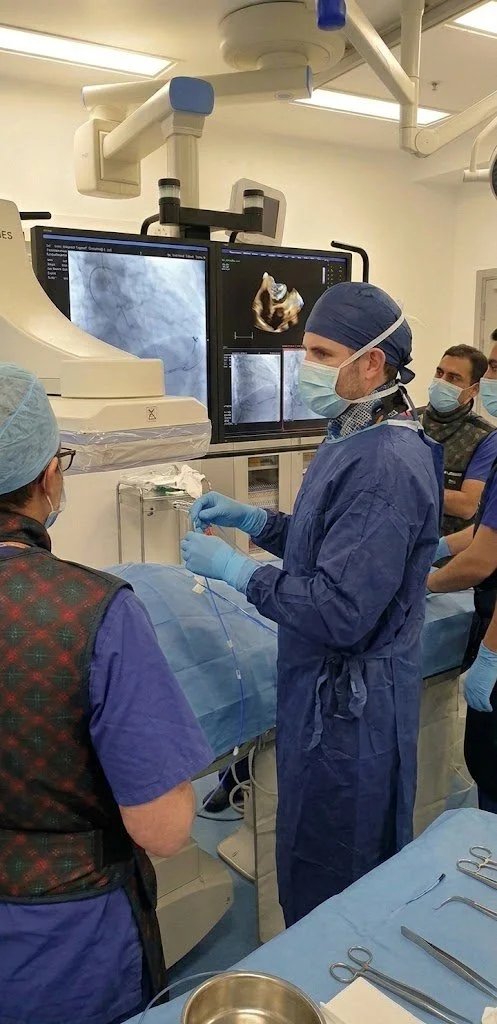
Transcatheter Edge-to-Edge Repair (TEER) / MitraClip
Transcatheter edge-to-edge repair treats a leaking mitral valve without open-heart surgery. A small clip is delivered by catheter through a vein in the leg and attached to the mitral valve leaflets, drawing them together so the valve closes more completely.
How it works
Access: through the femoral vein in the groin, then across the wall between the two upper chambers of the heart.
Anaesthetic: performed under general anaesthesia.
Guidance: the clip is positioned using transoesophageal echocardiography and X-ray.
Adjustment: the clip is repositioned until leaflet grasp and reduction in the leak are satisfactory. More than one clip may be used.
Who it suits
Primary (degenerative) mitral regurgitation: the valve itself is damaged, usually a prolapsing or flail leaflet. Surgical repair remains the preferred treatment for most patients; TEER is an alternative for those at high surgical risk with suitable anatomy.
Secondary (functional) mitral regurgitation: the leaflets are normal but the ventricle or atrium has enlarged. TEER is considered for selected patients who remain symptomatic despite optimised heart failure therapy.
Assessment always includes transoesophageal echocardiography to characterise the valve, and a Heart Team discussion weighing surgical risk, anatomy and the likely durability of benefit.
Medical therapy should be optimised first. For secondary mitral regurgitation this means guideline-directed heart failure therapy, and cardiac resynchronisation therapy where indicated, with severity graded on echocardiography when the patient is euvolaemic and normotensive.
Risks and complications
Bleeding or bruising at the groin access site
Injury to the vein used for access
Residual or recurrent mitral regurgitation
Damage to the mitral valve leaflets, or narrowing of the valve
Clip detachment
Stroke
Death
Every cardiac procedure carries risk. Your individual risk depends on your age, heart function, valve and vessel anatomy, and other medical conditions, and is assessed and discussed with you in detail before any decision is made.
After the procedure
Most patients stay in hospital for 1–2 days after an uncomplicated procedure.
Antiplatelet or anticoagulant therapy is tailored to your circumstances.
Follow-up includes clinical review and echocardiography before discharge and at intervals afterwards.
Heart failure medications are reviewed and continued.
GP role
Refer patients with moderate-to-severe or severe mitral regurgitation, particularly with breathlessness, reduced exercise tolerance or heart failure.
Optimise guideline-directed medical therapy before and after the procedure.
Monitor fluid status, renal function and rhythm.
Arrange surveillance echocardiography as advised.