
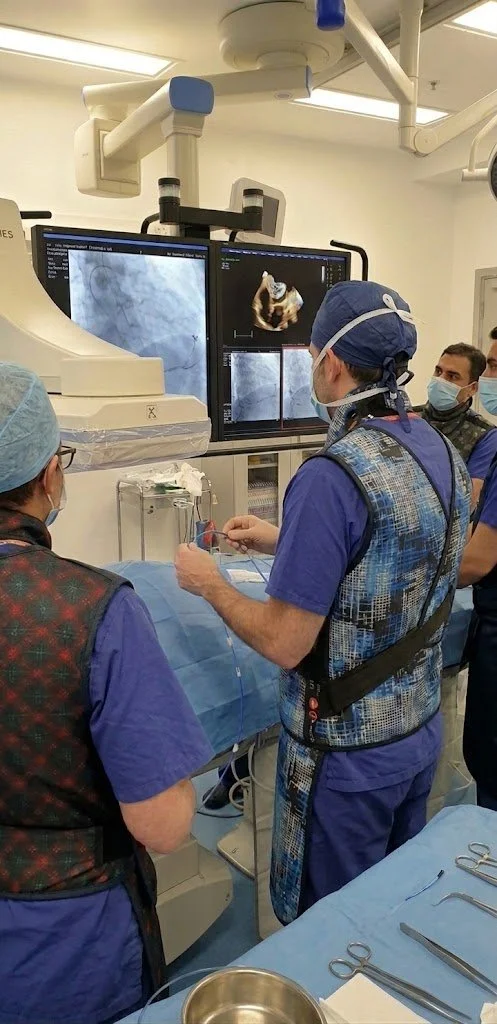
PFO Closure
A patent foramen ovale (PFO) is a small flap-like opening between the two upper chambers of the heart, present in around a quarter of adults. It usually causes no problems. In selected younger patients who have had a stroke with no other explanation, it can allow a clot to pass from the veins to the brain — and closing it reduces the risk of a further stroke.
How it works
Access: through the femoral vein in the groin.
Anaesthetic: sedation or general anaesthesia.
Delivery: a double-disc device is advanced across the PFO and opened on either side of the septum, sealing the opening. Heart tissue grows over the device in the months afterwards.
Duration: the procedure usually takes under an hour.
Who it suits
Age 18 to 60 — the range in which the evidence is strongest.
An ischaemic stroke confirmed on brain imaging, with no other cause found after full investigation and prolonged rhythm monitoring excluding atrial fibrillation.
A large right-to-left shunt, or an atrial septal aneurysm, on echocardiography with a bubble study.
No competing cause such as significant carotid disease, small vessel disease or a thrombophilia. Current evidence does not support closure where the PFO is unlikely to have caused the stroke, or outside the age range studied.
Risks and complications
Bleeding or bruising at the groin access site
Atrial fibrillation, most often in the weeks following the procedure
Device malposition, or a residual shunt
Clot forming on the device
Injury to the heart or surrounding structures
Stroke
Death
Every cardiac procedure carries risk. Your individual risk is assessed and discussed with you in detail before any decision is made.
After the procedure
Most patients go home the same day or the following day.
Antiplatelet therapy — aspirin, sometimes with clopidogrel for a period — is usually recommended. Long-term anticoagulation is not routine unless required for another reason.
Echocardiography confirms device position and closure at follow-up.
Endocarditis prophylaxis is advised for a period after implantation, and strenuous activity is limited briefly.
GP role
Refer patients under 60 who have had an ischaemic stroke or TIA with no cause identified.
Ensure prolonged rhythm monitoring has been completed — undetected atrial fibrillation changes management entirely.
Continue antiplatelet therapy as advised and review at follow-up.
Ask patients to report palpitations after the procedure promptly.